
Summary
China’s e-commerce sales grew 33% last year despite slowing economic growth.
China’s shift to a consumption-led economy has shown some results and the government’s continued effort to boost consumption should help drive the e-commerce industry in the future.
China’s internet penetration is about 50%, e-shopper penetration is about 35% and online sales represent less than 20% of total retail sales suggesting room for growth.
Alibaba is neatly positioned to exploit this long-term opportunity.
Please take note this is only one aspect in weighing the attractiveness or non-attractiveness of the companies mentioned as an investment and should not be used independent of other factors. This article examines one segment of the companies' businesses, and other factors such as valuation are not addressed.
China recorded economic growth of 6.9% in 2015, its slowest in 25 years.
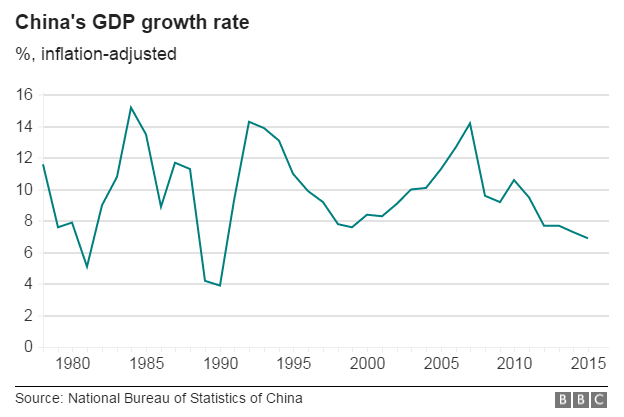
Source: BBC
Yet, retail sales of consumer goods, let alone services, still grew at a rate of around 10% per annum.
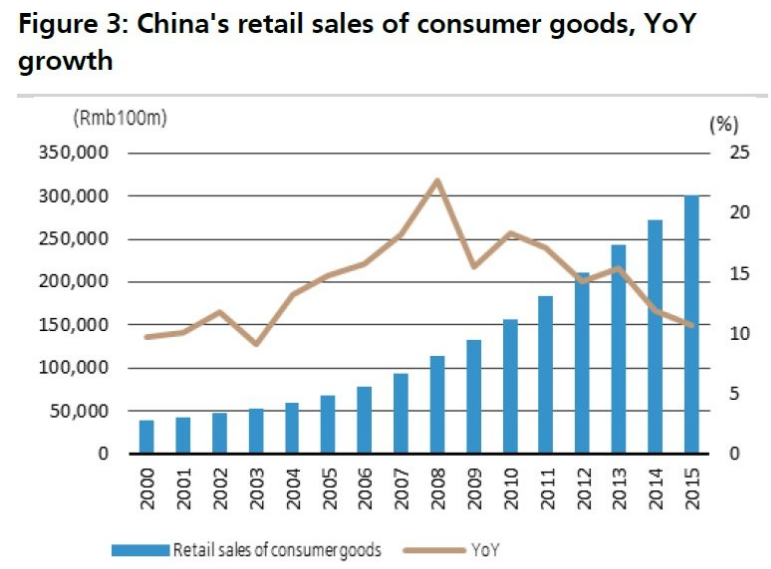
Source: UBS, Business Insider
Research firm eMarketer expects China to overtake the United States this year as the world's largest retail market.
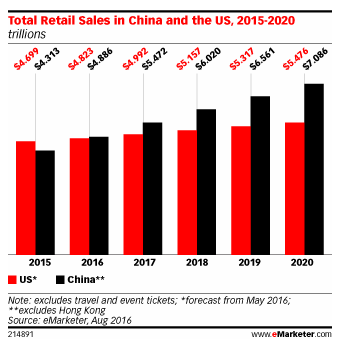
Source: eMarketer
E-commerce sales growth was strong as well. Despite relatively unexciting GDP growth, China's online sales last year reached their highest level since 2012, recording growth of 33% totaling 3.8 trillion yuan (about US$589 billion), according to the National Bureau of Statistics in China. By comparison,U.S. online retail sales increased 14% in 2015 over the previous year, totaling US$341 billion according to non-adjusted estimated from the U.S. Commerce Department.
China-Half of online sales
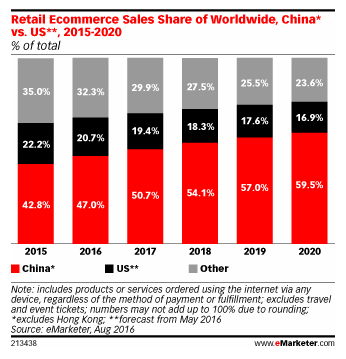
China, which overtook the United States as the world's largest e-commerce market in 2013, is expected to retain its leading position this year, with sales expected to exceed $899.09 billion, representing nearly half (47.0%) of online retail sales worldwide.
Consumption constitutes about 70% of America's economy, whereas in China it accounts for less than 40% of GDP.
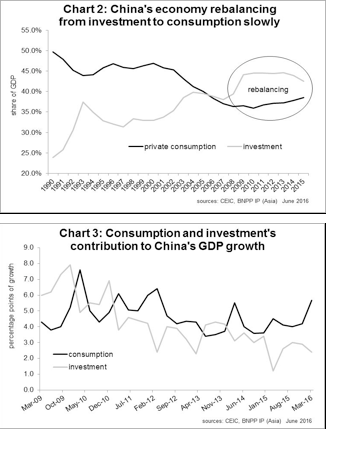
Source: The SWIFT Institute
China's shift to a consumption-driven economy appears to be showing some results. This year, final consumption accounted for 73.4% of China's first half GDP growth. In 2015, final consumption accounted for 66.4% of China's economic growth.
These statistics reflect the relative resilience of Chinese consumption. For instance, in 2015, despite economic growth slowing to its lowest growth rate in 25 years China's box-office revenues shot up nearly 50% YoY, international tax-free shopping leaped 58% according to Switzerland-based Global Blue andChinese tourism spending soared 53% YoY in 2015 to a record US$215 billion.
According to Andy Rothman of Matthews Asia, strong private consumption is not necessarily due to stimulus but also due to strong income growth and low debt (Chinese household debt is about 40% of GDP, roughly half the level in America). Advisory firm Willis Towers Watson estimates that white-collar salaries are now significantly higher in China than in Southeast Asia. A recent studystudy by consultancy firm McKinsey found that 55% of consumers in China are confident that their incomes will rise significantly over the next five years.
With the Chinese government's ongoing efforts to boost consumption, this trend is likely to continue. As part of a broader tax code overhaul, the Chinese government recently introduced tax breaks which should help boost consumer expenditures going forward. This year, the Finance Minister unveiled plans torevamp its income tax system to include deductions such as mortgage interest, education expenses and childcare expenses.
Even if China's GDP growth slows to 5.5% (below the official target), incremental Chinese consumption over the next five years will roughly equal a market 1.3 times the size of Germany or the UK.
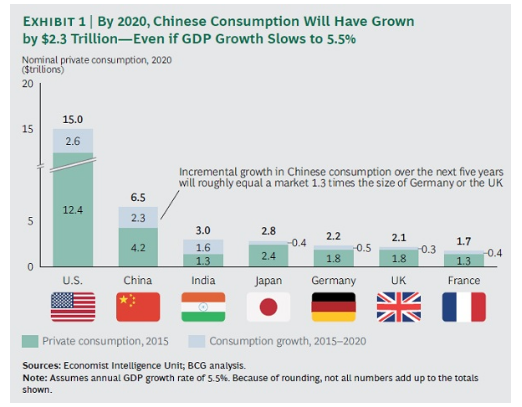
Source: eCommerce Insights
China is the largest e-commerce market in terms of sales and number of shoppers.
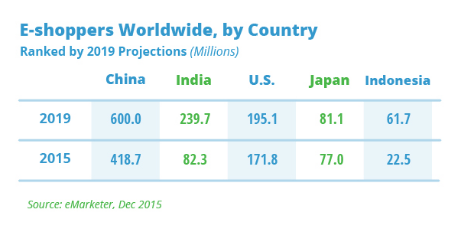
Source: eMarketer
And the Middle Kingdom is expected to retain this position going forward.
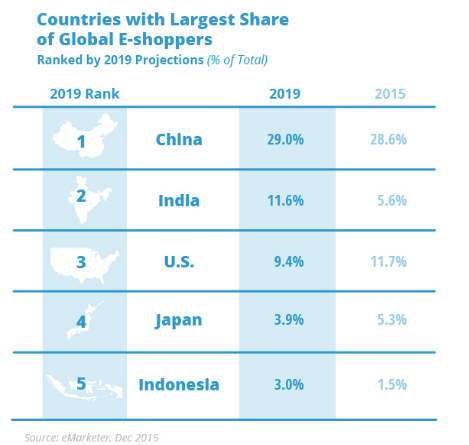
Source: eMarketer
Currently, less than 40% of China's population shops online leaving ample room for growth. By 2019, this is expected to increase to 51% of the total Chinese population.
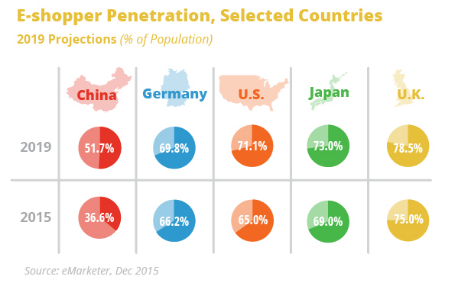
Source: eMarketer
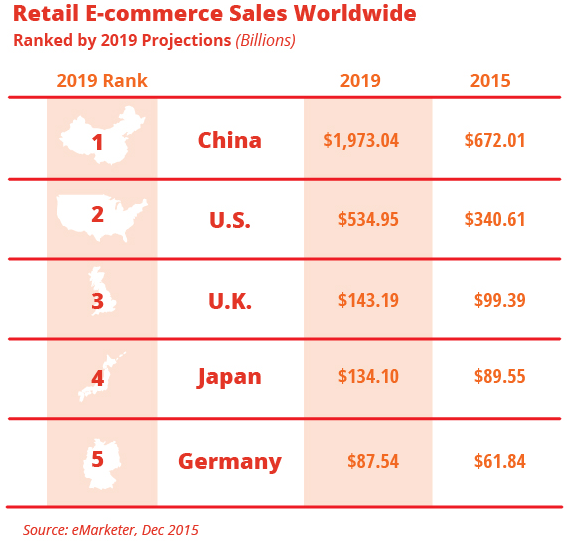
In terms of sales, last year, almost 419 million mainlanders made purchases online, spending $672 billion, nearly twice U.S. online spending in 2015. By 2019, Chinese shoppers are expected to spend nearly US$2 trillion online (3.6 times more than American e-commerce sales), representing an annual growth rate of 31%.
Source: eMarketer
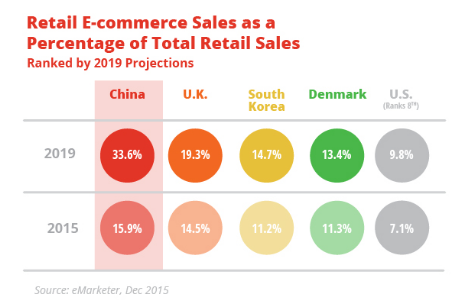
Currently, online retail sales make up less than 20% of China's total retail sales - there's still room for growth. By 2019, it is predicted that one-third of Chinese retail sales will be made online.
Source: eMarketer
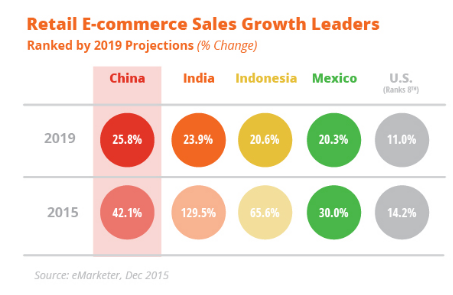
These factors are expected to drive China's e-commerce market. eMarketer expects China's e-commerce sales to continue showing rapid growth.
Source: eMarketer
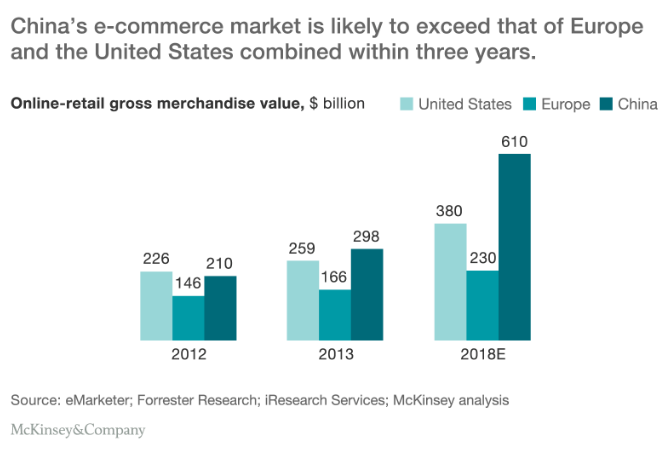
Some experts suggest that China's e-commerce market could grow to be larger than the United States and Europe combined within three years.
Source: McKinsey & Company
eMarketer expects China to continue increasing its share of global online retail sales over the next four years. By 2019, over 50% of global online sales will be from China, up from 40% in 2015.
Source: eMarketer
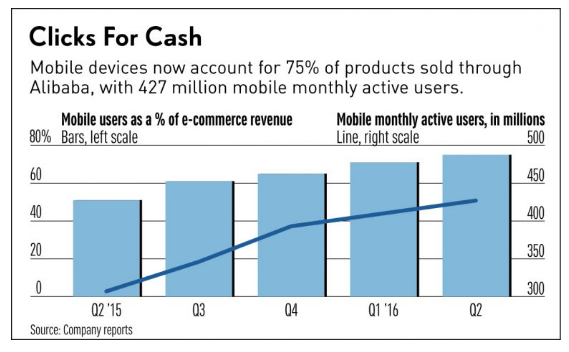
Mobile devices account for 75% of Alibaba's sales.
Source: Investor's Business Daily
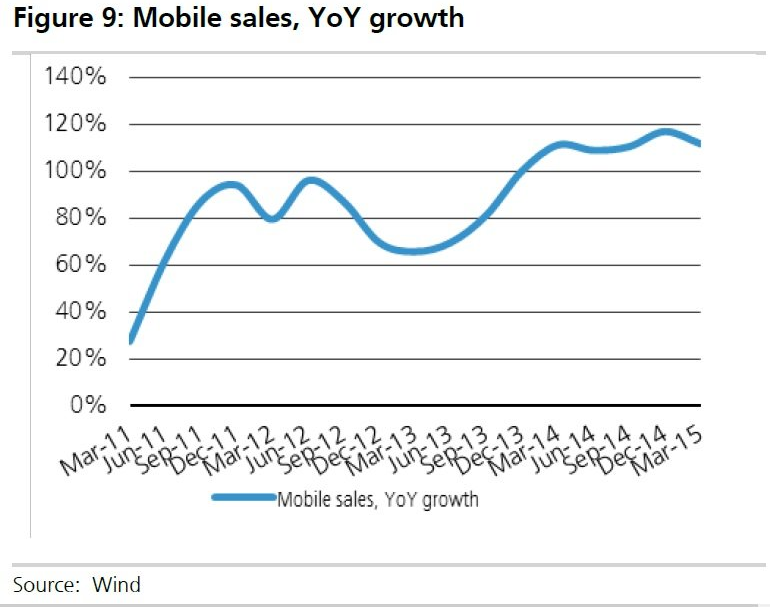
With the continuous increase in mobile data usage (data traffic on Chinese mobile devices jumped almost 50% last year), online shopping also is on the rise, growing by over 100%, continuing a trend seen since 2013.
Source: Business Insider
Yet, China's mobile internet user base makes up about half of its 1.3 billion population. According to statistics from China Internet Network Information Centre, the number of mobile internet users reached 656 million, about 92% of China's total internet users which stood at 710 million, about 51% of the population as of June this year, leaving room for growth. Ericsson estimates China will add 210 million mobile subscriptions between end 2015 and 2021.
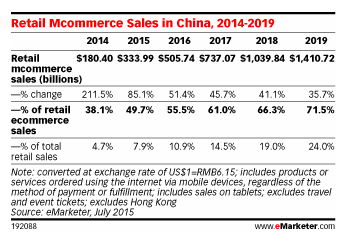
Consequently, it is expected that sales on mobile devices as a proportion of total online sales will increase to 71% by 2019, up from an estimated 55% in 2016.
Source: eMarketer
Of China's 1.3 billion population, 43% are aged between 10-39 years and this age group makes up 80% of China's internet users.
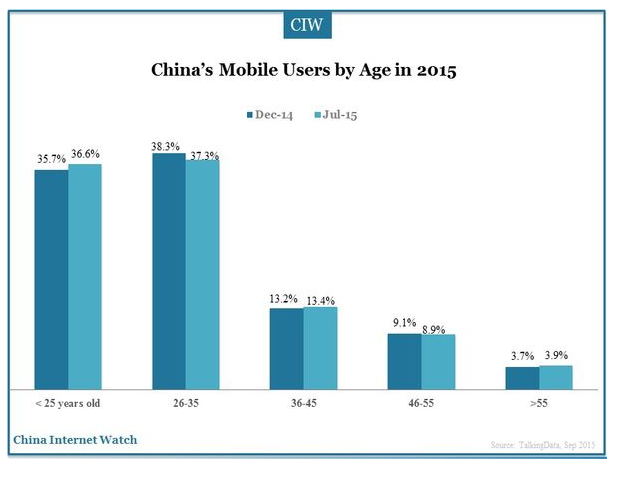
Source: China Internet Watch
As their wealth and numbers increase, they are set to become China's most influential group of consumers in the next few years which should help propel growth in online and mobile consumption benefiting retailers and e-commerce firms.
China's e-commerce juggernaut Alibaba, which commands nearly 80% of China's e-commerce market (a market position so strong even Amazon opened a store on Alibaba's B2C online market platform Tmall), is neatly positioned to exploit this long-term opportunity.
Disclosure: I/we have no positions in any stocks mentioned, and no plans to initiate any positions within the next 72 hours.
I wrote this article myself, and it expresses my own opinions. I am not receiving compensation for it (other than from Seeking Alpha). I have no business relationship with any company whose stock is mentioned in this article.

No comments:
Post a Comment